


Health Competence
Train your brain (ENG)
Gear up with mental tools for life! This is a 6-week ACT-based training program guided by neuropsychologist Gabriella Svanberg. You can complete it individually or in a group. Orders can be placed via info@healthcompetence.se.
6 week mental training program
This training program is for anyone who wants to reach their full potential and get the most out of life. Throughout the program, we strengthen our mental ability to be present, find focus, stability, and make conscious choices based on our personal values using various ACT (Acceptance and Commitment Therapy) exercises. It is a digital training program designed to equip us with mental tools to better handle and face life's challenges. This leads to reduced stress, anxiety, and worry, improving our quality of life and enhancing performance both privately and at work.
Target group
The program is suitable for all adults who want to develop their mental strength and stability. It is also suitable for those struggling with stress, anxiety, worry, difficulties disconnecting, or dealing with limiting fears or judgmental thoughts. The program can be carried out individually or in collaboration with the workplace, with Gabriella Svanberg as coach.

Guided by Gabriella Svanberg
Licensed Psychologist & Specialist in Neuropsychology
Gabriella is a psychologist with over 20 years of experience. She is also a mindfulness instructor, lecturer, and has extensive experience working in occupational health. In her dissertation, Gabriella implemented and conducted research within the field of Acceptance & Commitment Therapy (ACT).
About 30 min per week
Expect to set aside approximately 10–30 minutes per week. Go through the content of each episode and try at least one exercise. It’s important that you check off and confirm when you have completed each week. Feel free to go back and revisit the content for repetition.
Based on scientific research
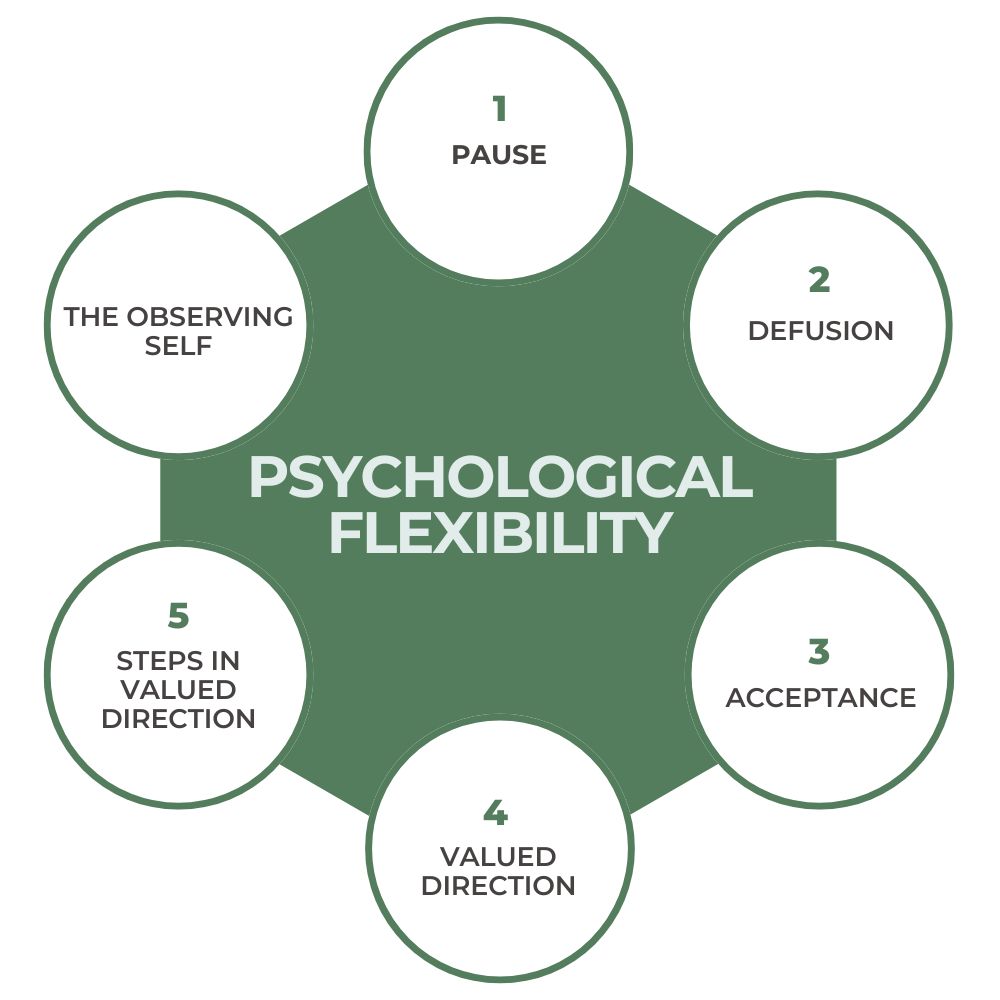
The program is based on ACT, Acceptance and Commitment Therapy, which is a scientifically validated form of behavioral therapy. ACT is about accepting what cannot be changed and committing to acting in line with one’s values. Within ACT, and throughout the program, we train six core skills: pause, defusion/distance, acceptance, valued direction, steps in valued direction, and the observing self. Altogether, these skills aim to develop our psychological flexibility.
Log in to start
All structure and content of the program is gathered on this page. Make sure you are logged in before each session. After completing each section, you will receive a confirmation email from us.

.jpeg)
How the Program Works
The program begins right away with the first training area, pause.
Each area starts with a short introduction video. You are then encouraged to try one or several exercises within each area, discover your favorites, and repeat them several times throughout the week.
Remember to check off at the bottom of the section once you’ve gone through the content. If you’ve marked a section as completed, you can always go back, repeat, and revisit the content again.
Formal and informal exercises
You will be offered both formal and informal exercises in each session.
Informal exercises are like training your core while carrying grocery bags—that is, out in everyday life. Formal exercises are more like doing sit-ups, such as a guided mindfulness practice.
How Can We Train Our Brain?
In recent years, researchers have discovered that the brain is significantly more adaptable than previously believed. This means that it is actually possible for us to train and reprogram our brains. For many years, the Dalai Lama has shown great interest in brain research and has regularly gathered leading neuroscientists for information and discussion. Since the late 20th century, scientists have realized that our brains are affected by our experiences—even by our thoughts. This ability is called neuroplasticity, and there are ways we can train our brains to feel better.
Mental training
"Leading brain researchers have shown a number of positive changes in the brain from practicing mindfulness. The right frontal lobe regulates emotions such as irritation, anger, fear, and depression. It also plays a role in controlling our fight-or-flight response. The left, corresponding part regulates emotions with a positive tone such as enthusiasm, interest, curiosity, joy, and happiness. With regular mindfulness training over a couple of months, activity shifts from the right to the left side—that is, from irritation and stress to calm and joy," writes Ola Schenström, physician and author of the book Mindfulness i vardagen (Mindfulness in Everyday Life).
One of the leading brain researchers, Richard Davidson, now says that “happiness is a skill.” In other words, happiness is something we can learn. When we train our brain, as in this program, we can see benefits such as:
- Improved attention
- Improved compassion
- Reduced mind-wandering
- Better conflict management
- Higher levels of cognitive control

Intro: Pause
Learn how to pause and become aware
The first training area is about pausing. Taking a pause works a bit like pressing the pause button when you’re watching a movie.
.jpg)
Task 1: Breathing Anchor
A guided breathing exercise
Gabriella guides you through a 7-minute focus exercise where you get to practice pausing. You are encouraged to repeat the exercise, and you can always return and do it again later.

Task 2: Body Scan
A guided exercise to train our focus
Lean back, close your eyes, and listen to this guided exercise designed to reduce stress and increase your sense of presence. The exercise can also be used to help you fall asleep.
You are encouraged to repeat the exercise, and you can always return to it later.
Informal exercises
Below are three suggestions for simple exercises you can incorporate into your daily life.
- In a conversation, notice your mind’s tendency to jump ahead and maybe start planning something. Consciously bring your attention back to what the other person is saying. Notice which words they use, their tone of voice, facial expressions. When it’s your turn to speak, notice what you feel and try to speak in a way that aligns with that, rather than from an unconscious, automatic response.
-
When eating, take a moment to observe your food before taking a bite. Simply notice as much detail as possible—colors, shapes, textures—as if you were seeing this food for the first time.
-
Listen to music. Close your eyes and turn your attention to the music. Notice what you feel while listening. Be aware of the thoughts that arise within you, then gently return your attention to the music.
Read more about pausing
There’s a big difference between being present and not being present. To understand presence, we can reflect on what it means to be absent. Have you ever walked into a room and forgotten why you went there? Or had to reread the same passage in a book several times because your mind kept drifting? Pausing and interrupting this semi-conscious state—to become awake, clear, and alert—is an art. We can only change what we are aware of, which is why learning to pause and be present is such a valuable first step.
Think about a moment when you felt truly happy and alive. Were you fully focused on what you were doing or experiencing right then? Practicing present-moment awareness also creates more opportunities in life where we feel truly alive and well.
Autopilot and Automatic Reactions
It’s said that we often run on autopilot—a kind of everyday trance where our thoughts and emotions are triggered unconsciously. Our brain naturally tries to automate tasks, which has many advantages, but if we’ve developed destructive automatic patterns, we need tools to pause and create new ones.
Self-Assessment Test
Measure and evaluate your psychological tools
Answer the questions below to assess your psychological tools. The responses are anonymous and only you can see your results. Answer the questions as truthfully as possible. After 6 weeks, you will answer the same questions again to identify any changes. Once you’ve completed the weekly tasks, confirm it at the bottom of the section by clicking the "Done" button. Please note that you need to be logged in to do this.
1 = Never
7 = Always
Intro: Defusion
Why it's important to create distance from your mental chatter
Defusion means creating distance. By taking a step back and noticing your thoughts as they come and go, you become more present in the moment. This helps you choose which thoughts are useful and which are not, so you can focus on what actually supports your values and goals.

Task 1: Breathing Space
A guided exercise to create distance from thoughts and emotions
In this exercise, we practice opening up our awareness, rather than focusing it on a single point like we did last week. You are encouraged to repeat the exercise, and you can always return to it and do it again later.
Task 2: Emotions, Thoughts & Physical Sensations
Below are three reflection questions that you're encouraged to answer. Write down your responses on your phone, on a paper, or in a document that you can return to later in the program.
- What are the emotions that disturb you the most, that you would like to get rid of? See if you can identify a feeling rather than a thought or physical sensation. For example: anger, worry, sadness or jealousy. Note 3 of them.
- What are some thoughts that tend to upset you and that you would like to reduce or get rid of? See if you can identify a thought rather than a feeling. Thoughts often come as a stream of words popping up in your mind—like “I’m not good enough,” “I should’ve said or done this,” “I’m so bad,” etc. These thoughts may be about yourself, others, the future or the past, or something else. Note 3.
-
What are some physical sensations that feel unpleasant and that you would like to reduce or get rid of? For example: increased heart rate, hot flashes, physical trembling, fatigue, pain, or discomfort in the stomach. Note 3.

The Mischievous Kids Theory
Imagine you’re standing in a grocery store, about to pay. You’ve brought two busy kids with you who are standing next to you. They start arguing just as you’re about to check out, but you stay calm and keep your focus on the cashier and getting your card ready.
It’s not that you don’t notice what the kids are doing. Of course you do. It’s not that you don’t have thoughts or feelings of irritation—but you try not to give them your attention.
Instead, you ignore the kids in the moment and keep your focus where it needs to be: paying for your groceries.
This is an example of noticing without giving attention.
Read more about defusion
The goal of defusion exercises is to see thoughts as just thoughts, without getting stuck in them. It’s not about eliminating or fighting against them, but rather about relating to them in a more effective way.
By observing your thoughts without fusing with them, you can free yourself from the unhelpful thinking that gets in the way of your well-being.
In the beginning, we often only notice distractions once we’ve already been "kidnapped" by them and are deeply caught up. But with practice, you can learn to catch a distracting thought before it fully forms.
Here are a few ways to handle a distraction:
-
You choose not to engage with the distraction.
-
You notice the distraction—e.g., you get a text, so you take a pause to reply, then return to your focus.
-
You choose the distraction—e.g., you reply to the message and make it your new focus.
Like a Radio Playing in Another Room
One way to free yourself from a thought is to imagine it as the sound of a radio playing in another room. You can hear it, but you don’t need to listen or get caught up in it.
If you notice a thought that sticks, take a step back and observe it as “just a thought.”
By doing this, you can develop a more flexible and accepting relationship with your thoughts and focus on what truly matters to you in the moment.
Intro: Acceptance
How do we create more space for our emotions
Acceptance isn’t about giving up or feeling defeated—it’s about adopting a non-judgmental attitude toward our experiences.
It doesn’t mean everything is okay or that we can’t change things, but it does mean that we stop resisting what is and instead accept it.
By opening up to difficult emotions and sensations, we can create space for them to be there, rather than fighting against them.

Task 1: Accept Your Thoughts
An exercise to practice acceptance
This exercise is about observing our thoughts without getting caught up in them, and letting go of them when they no longer serve a purpose.
We practice releasing thoughts and emotions that do not help us.
You are encouraged to repeat the exercise, and you can always return and do it again later.
Informal exercise
Below is a guided exercise to help you notice your emotions. Follow the guide step by step and feel free to bring the exercise into your daily life.
-
Notice and name what you're feeling right now (emotions can be described with words like happy, excited, bored, frustrated, angry, sad, anxious, or stressed). If you're unsure what you're feeling, simply note whether it feels pleasant, neutral, or unpleasant.
-
Notice that you are actually noticing your feelings.
-
Notice how you know what you’re feeling. Where in your body is this emotion showing up? (Is it in your chest? Stomach? A sense of worry?)
-
Point to the part of your body where the emotion feels strongest. If you feel it all over or have trouble pinpointing a specific spot, simply touch any area of your body—perhaps your chest area.
-
There it is—the emotion—and there is the awareness of it. Nothing more, nothing less.
-
As your day continues, keep noticing your emotions (both good and bad) and acknowledge them just as you did here.
-
You might notice how you feel when you're talking to a colleague at work, when you're rushing from place to place, sitting in traffic, waiting for the water to boil, or when you're sitting at your desk at work.

A Metaphor: The Wild Horse
A student approached the master, bowed, and asked:
“My mind is very hard to control. When I want certain thoughts to disappear, they remain. And when I want other thoughts to stay, they vanish. How can I control my thoughts and my mind?”
The master replied:
“Think of your mind as a wild, untamed horse. If you try to control it by force, it becomes agitated and restless. If you try to make it stand still, it will kick and resist even more.
Instead, try letting go of the reins and allow your mind’s wild horse to run freely across the field. Without anything to resist, it will gradually begin to calm down on its own.
Once it has settled, you can begin to tame it. And when it’s tame, you can start to train it. Eventually, you’ll learn to ride your mind like a horse, and it will soon carry you wherever you want to go.”
Read More About Acceptance
None of us goes through life without experiencing grief or psychological pain. To live means that we sometimes have to face complicated, difficult, and painful things.
We often create our own suffering by setting unrealistic expectations for how we should be—expectations that are impossible to live up to and that generate guilt and shame.
To achieve happiness, people have often developed ways to escape or avoid discomfort. Unconsciously, we twist and turn to find ways to avoid unpleasantness. But turning a blind eye to what's happening doesn’t actually solve anything.
We may dive into work to avoid stopping and feeling, or distract ourselves with shopping, eating, or other means of numbing the reality we're in.
The serenity prayer
There’s something known as the Serenity Prayer, which goes:
“Grant me the strength to change the things I can, accept the things I cannot change, and the wisdom to know the difference.”
It's called the Serenity Prayer for a reason.
Definition of acceptance
Acceptance is not the same as liking something. Acceptance means being willing to see, face, and endure both your inner and outer reality—without fleeing, avoiding, distorting, or judging it—and to act based on that reality in an effective way, aligned with your values and goals.
Supply & Demand
We can place very high demands on ourselves. For example:
"I’m going to host a dinner and it has to be perfect. The food should be amazing, the table beautifully set, everything spotless, and the wine top-quality."
But if you also have a high level of supply—plenty of money, time, energy, creativity, talent—there’s no stress.
We can also have low expectations:
"I’m just serving some chips."
And if your supply is also low—no time, no energy, little support—that’s still not stressful.
Stress arises when there’s an imbalance between supply & demand.
When the demand is greater than the supply, we feel inadequate.
You might think your presentation isn’t good enough, or you’re not fit or organized enough.
To find peace of mind, supply and demand need to be balanced in the moment. Let’s say you have a certain demand or ideal in mind — for example: "This is how I want my dinner to be." Ask yourself: "What can I realistically change right now to match that demand?" Maybe: "I can bake a pie, tidy up a bit, and light some candles." But also ask: "What do I need to accept as it is?"
Understanding that difference is key. To experience calm, we need to change what we can in the moment, accept what we can’t, and develop the wisdom to know the difference.

Intro: Valued Direction
How do we find our inner values?
It's important to find direction in life. "If you don’t stand for something, you’ll fall for anything." In this week’s session, we explore our valued direction.
Here are a few examples of different values:
-
Being open and accepting
-
Actively seeking
-
Creating new experiences
-
Respectfully standing up for your rights
-
Being caring
-
Continuing to challenge yourself
-
Acting with compassion
Task 1: My 95-Year-Old Self
An exercise to discover your inner values
Gain greater clarity about what truly matters to you in life. In this exercise, Gabriella guides you in exploring your personal values by inviting you to imagine yourself at 95 years old.
Remember, there’s no right or wrong. We may all have different values. What’s important is that your values align with your inner convictions and beliefs.
Task 2: Reflect on What Matters
Below are five questions to ask yourself. Take your time, reflect in peace and quiet, and write down your answers on your phone, on paper, or in a document you can return to later in the program.
-
Think back to a time in your life when you felt it was truly meaningful. What was that like?
-
Imagine yourself 10 years from now, looking back. What would you have liked to have done and lived for during the past 10 years?
-
Think of someone who inspires you. What do they stand for? What qualities do you admire in them?
-
If fear wasn’t a problem, what would you do in your life? What would others see you doing that you’re not doing today?
-
If everyone respected your choices no matter what, what would you choose to do that you’re not already doing?

A Metaphor: The Fisherman
A poor fisherman was sitting on the beach when a wealthy businessman walked by.
"Why are you sitting here doing nothing?" asked the businessman.
"Because I’ve already caught enough fish for today," replied the fisherman. "Now I’m just sitting here enjoying the afternoon sun."
The businessman shook his head.
"Now that you have time, you could catch even more fish. Don’t just sit here and waste it."
"What would I do with that fish?" asked the fisherman.
"You could sell it and make a lot of money," said the businessman. "Then you could buy a bigger boat with a stronger engine and fish even farther out at sea. You’d be able to catch even more fish and make even more money."
"And then what?" asked the fisherman.
"Then," said the businessman, "you could sit back and enjoy life."
"But that’s exactly what I’m doing right now," said the poor fisherman.
Learn More About Values
Values are like your compass in life. Maybe you want to be open-minded, flexible, thoughtful, helpful, respectful, reliable, loyal, responsible, kind, and so on.
Note that even if you sometimes take steps that align with your values—or even steps that completely go against them—you can still feel good in your heart as long as you know that you were true to yourself, that you lived and acted in line with your values and as the person you want to be.
Values are not the same as goals. There’s a difference between someone who is values-driven and someone who is goal-oriented. In ACT, the term “value” refers to the activities and directions that give life meaning. Our values describe how we want to be as people, where we want to go, how we want to live, and what we want to stand for.
Values are not something you complete. They’re something you work with throughout life. It could mean being a respectful person, an honest person, or a reliable friend. Values are like a compass; they help us make choices based on the direction we want our lives to take.
A goal, on the other hand, is something you can achieve and check off—like getting a job, entering a relationship, or running a 10k in under 55 minutes. You can succeed or fail at a goal.
Succeeding with Your Values
If your definition of success is only based on whether you reach your goals, you may be ambitious and accomplish a lot—but you’ll only feel good when things go well. You’ll reward yourself only after you’ve achieved something, and it can be a tough road. If you don’t reach your goals, there’s a risk of crashing hard.
But if you define success as living according to your values, you can still set goals and be ambitious, but there’s a difference: you’ll feel satisfied regardless of the outcome, as long as you acted in line with your values.
This doesn’t mean you stop trying—it means you move through life more calmly, even when things don’t go as planned. The difference is knowing you’ve done the best you could, regardless of the result. After all, you can’t change everything in the moment. But you can accept where you are and keep moving forward.
Intro: Steps in a valued direction
Taking steps in our valued direction
We do not get anywhere by only setting values. We also need to take steps in our valued direction. And remember, a journey of a thousand miles begins with a single step. That step can be as small as anything, as long as it moves you in your direction.
Task 1: Life Compass
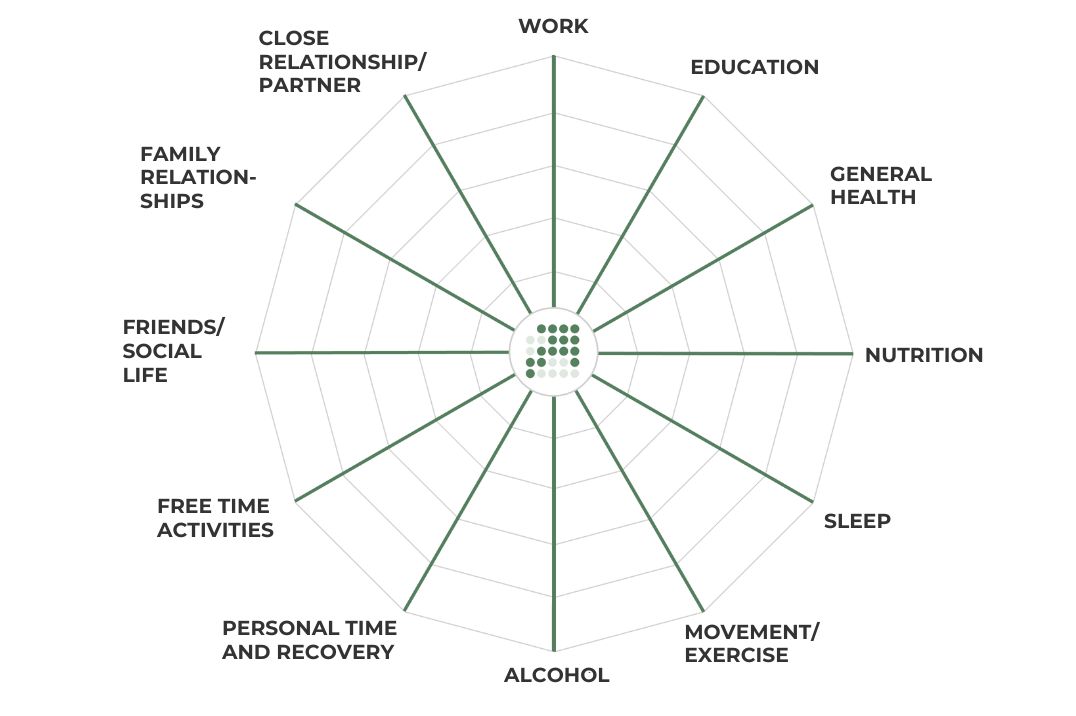
Fill in your life compass
In the “Life Compass” task you will see different areas of life. The scale goes from the outer edge = 10, to the center = 0, where 10 means it is as good as it can be, and 0 means poor. Feel free to print it out or paste the image into a document where you can sketch. Set a date when you complete it. You can repeat the task regularly with some time in between to track your development.
Download a PDF of the Life Compass here
Mark a point within each area. This exercise is only for you. You do not need to show it to anyone and there is no right or wrong. You decide where on the scale you want to place your mark.
The purpose of the task is to give you ideas about what you value in life and what you want more of, or what you want to start working on.
Task 2: What steps do you want to take?
Use the questions below to reflect. Write your answers down on your phone, on paper or in a document you have used earlier in the program. This exercise helps you gain clarity on which steps you want to take in your chosen direction.
-
What could you do that would be a step in the right direction toward the person you want to be?
-
What is the first step you could take that would bring you closer to a better balance between work and life?
-
What are some things you could do that would mean taking better care of yourself?
-
Do you know someone who is good at taking care of themselves? What is it that makes this person so caring toward themselves, and could you do the same?

Metaphor: The Swamp
Imagine you're starting a journey toward a beautiful, wonderful mountain that you can clearly see on the horizon. The first thing that happens as you begin is that you step straight into a swamp that stretches as far as the eye can see in every direction. You tell yourself, “Oh no, I had no idea I’d have to go through a swamp.” It smells like mud, and the dirt has gotten into your shoes. It’s hard to lift your feet because the muck clings to your soles. You’re wet and tired. Why did no one mention this swamp?
When that happens, you have a choice – either you abandon the journey or you go through the swamp. That’s life. We go into the swamp not because we want to get muddy, but because it lies between us and where we want to go.
Read more about steps in valued direction
The size of our steps varies from day to day. It can depend on the terrain and our own condition. Some days we can take bigger steps, while other days we need to take smaller ones. We need to learn to crawl before we can learn to walk. Everything feels easy once you know it, but in the beginning, we all have to fumble our way forward. Sometimes we also just need to land and stay still. We don’t always have to grow and move forward.
Take steps of the right size
Just as we need to lift the right amount of weight at the gym, we need to take on psychological challenges in the right doses. We might know what we should do, but we may not be mentally ready. We might want to be the person who stands up for their friends, but not yet have the courage to speak up. Then we may need to accept that and practice standing up for things in smaller situations, training our courage.
Success is not always something you see
Only you can determine what is a step in your valued direction. It doesn’t have to be something others can see or notice. Skipping a pastry could be a step. Taking the stairs instead of the elevator might be a step. Holding the door open for a stranger could be a step. A small thing can mean a lot to someone – have you ever experienced someone doing something small that meant a lot to you?
Dare to make mistakes
We need to dare to test, to dare to fail in order to learn what works. We may need to fail over and over. Learning what doesn't work teaches us something that might be very important. It can be compared to going to a place you've never been. You may need to go the wrong way many times before you find the right one.
The path is made by walking
By acting the way we want, over and over again, we create new paths. We create new, good habits that become automated. If we walk through life on autopilot and destructively, it’s about stopping and choosing a new path until the new way becomes the new autopilot. Picture it like trails in the woods. If you want to create a new path, you have to walk over the grass so many times that it forms a trail. The more you do it, the better you get. We can train ourselves in new ways to act, and also new ways to think.

The Captain Metaphor
A summary of the ACT model
In this video, Gabriella explains the captain metaphor.
The aim is to create an understanding of how you can manage your limiting fears, and not feel held back from reaching where you want to go in life.
Task: The Matrix
Have you ever done things that feel good in the moment, but don’t take you in the right direction in life? When we have difficult thoughts and emotions, we often react by avoiding them, by fleeing. This might mean not saying what we want to say, avoiding things, acting aggressively, distracting ourselves with games, Netflix, or numbing ourselves with alcohol, pills, drugs, sex, etc.
The exercise The Matrix is a tool that summarizes the different steps we’ve worked with in this program. It’s a tool that helps us move toward things that are important to us.
.jpg)
- Box 1: What matters to you? Write down your dreams, values, what is important to you, who is important to you (e.g., family, being a loving parent, a loyal friend).
- Box 2: What unpleasant thoughts and feelings might show up? For example, anxiety, fear, guilt, self-criticism, jealousy.
- Box 3: What do you tend to do to escape or avoid? Say yes when you mean no, use distractions, alcohol, or avoid responsibilities.
- Box 4: What behaviors would you like to have? Speak up, end a harmful pattern, reach out to a friend, apply for a dream job.